
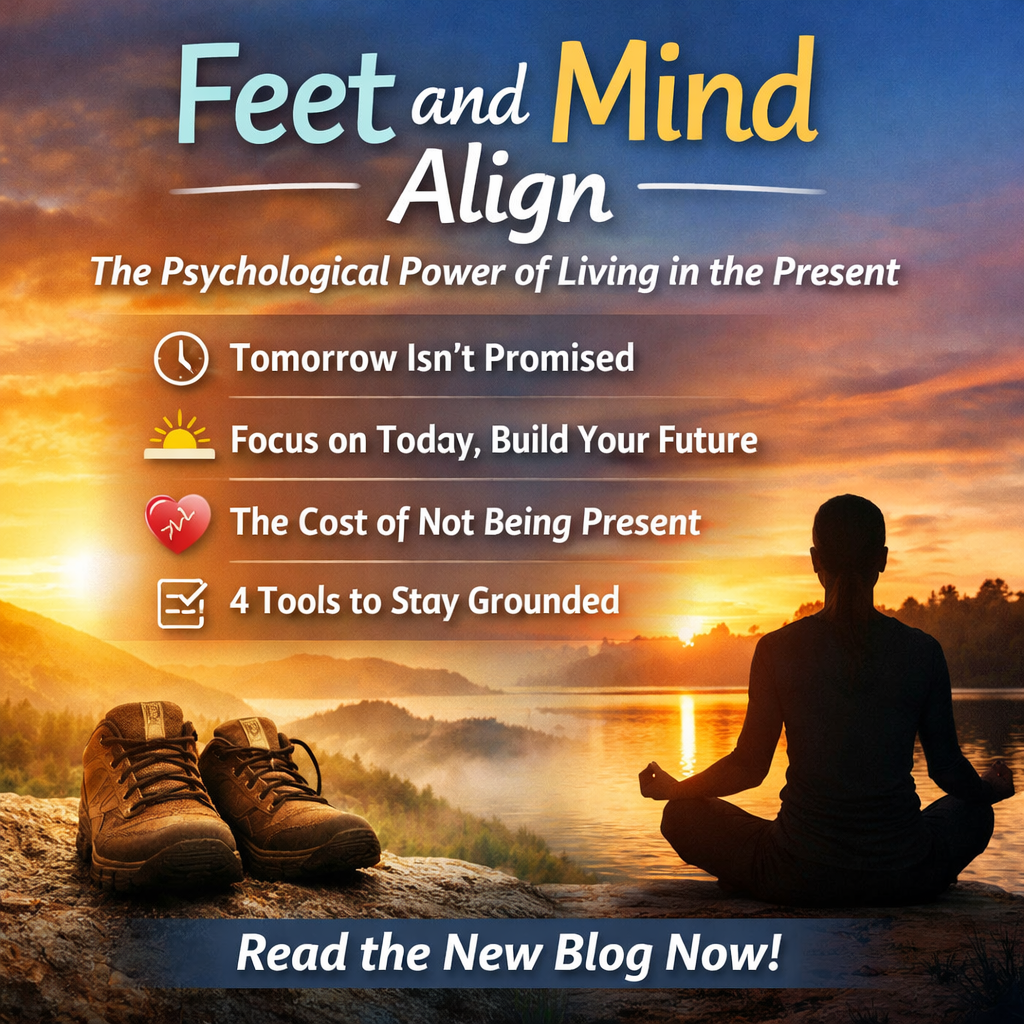
We spend so much of our lives everywhere but here.
Our bodies sit at the dinner table, but our minds replay yesterday’s argument. We tuck our children into bed while mentally drafting tomorrow’s to-do list. We go for a walk, yet we are miles away, lost in regret, anticipation, or worry.
What would happen if our feet and our minds were in the same place at the same time?
When your feet and your mind align, you are present. And presence is not just a spiritual concept, it is a psychological skill. Living in the present moment is one of the most powerful ways to regulate emotions, reduce anxiety, and build a life of sustainable success.
If you focus on today, tomorrow and yesterday take care of themselves. String enough “todays” together, and you build a lifetime.
Let’s explore why being present matters so deeply and how to train yourself to live there more often.
The Mind’s Natural Drift: Past and Future
The human brain is wired for survival. From an evolutionary standpoint, remembering the past and predicting the future kept us alive. The brain’s default mode network is constantly scanning:
What happened before?
What could go wrong next?
While this ability is useful, it becomes problematic when it dominates our awareness.
Living in the past often shows up as rumination, regret, shame and or “If only” thinking.
Living in the future often appears as Anxiety, Catastrophizing, Overplanning, and or Fear of uncertainty.
But here is the psychological truth: the only moment you have control over is this one. You cannot rewrite yesterday. You cannot guarantee tomorrow. The present moment is where choice exists. It is where behavior happens. It is where life is actually lived.
Tomorrow Isn’t Promised
We often operate under the illusion of guaranteed time.
“I’ll enjoy life when…”
“I’ll rest after…”
“I’ll say what I need to say later…”
But tomorrow is not promised. This isn’t meant to create fear. It is meant to create clarity.
Presence sharpens appreciation. When you are fully in a moment:
Conversations become deeper.
Experiences become richer.
Relationships become more meaningful.
Small joys become visible.
Psychologically, gratitude and presence are intertwined. When attention is anchored in now, the nervous system shifts toward regulation. Stress decreases. Emotional reactivity softens.
When your mind is not racing ahead or looping behind, you can finally experience what is right in front of you.
The Illusion of Control
Many people stay mentally in the future because it feels productive. Planning gives the illusion of control. Worry feels like preparation.
But worrying about something does not prevent it.
In fact, excessive future-focused thinking increases cortisol levels, fuels anxiety disorders, and depletes emotional energy. Similarly, excessive past-focused thinking reinforces depressive cycles.
Unfortunately, you cannot control the past, other people’s behavior and the outcome of every future event.
What you can control is your thoughts, your responses and your behavior today.
Presence brings you back to what is actually within reach.
Success Is Built One “Today” at a Time
People often imagine success as a dramatic breakthrough moment. But psychologically, success is built through repetition.
If you:
Make one healthy choice today,
Practice one disciplined habit today,
Respond with integrity today,
Show up with effort today
You are building success.
String enough days of aligned action together, and you create momentum. String enough momentum together, and you create mastery. String enough mastery together, and you create a lifetime.
You don’t need to solve your entire life today. You just need to align your feet and your mind for this one.
Four Practical Tools to Stay Present
(Using CBT and Grounding Techniques)
Presence is not passive. It is a skill that can be strengthened. Below are four evidence-based tools drawn from Cognitive Behavioral Therapy (CBT) and grounding practices that help anchor attention in the present moment.
1. The “What’s in My Control?” CBT Filter
CBT emphasizes identifying distorted thinking patterns and restructuring them.
When your mind drifts into past regret or future worry, pause and ask:
“Is this within my control right now?”
If the answer is:
No → Release it.
Yes → Identify one small action you can take today.
For example:
Instead of: “What if I fail this presentation next week?”
Shift to: “What can I do today to prepare?”
Instead of: “I can’t believe I handled that so badly.”
Shift to: “What can I learn from that, and what will I do differently next time?”
This technique interrupts catastrophic thinking and returns attention to actionable steps in the present. This will reduce cognitive distortions such as catastrophizing and rumination while increasing perceived agency.
2. 5–4–3–2–1 Sensory Grounding
Grounding techniques bring awareness back into the body. When the mind spirals, the senses anchor you.
The 5–4–3–2–1 method:
5 things you can see
4 things you can feel
3 things you can hear
2 things you can smell
1 thing you can taste (something jarring like a mint or something spicy)
This technique activates the sensory cortex and shifts attention away from anxious mental loops.You are not in yesterday. You are not in tomorrow. You are here.
This is especially powerful during moments of emotional overwhelm, panic, or dissociation. This works because it pulls the nervous system out of threat mode and back into present sensory awareness.
3. Thought Labeling (CBT Cognitive Defusion)
Instead of believing every thought, practice challenging it by labeling it.
When a thought arises, say:
“That’s a worry thought.”
“That’s a regret thought.”
“That’s a catastrophic thought.”
“That’s my perfectionism talking.”
By labeling thoughts, you create psychological distance. You are not your thoughts. You are the observer of them. This train of thought reduces emotional fusion with anxious or depressive narratives.
For example:
Instead of: “Something bad is going to happen.”
Shift to: “I’m having a worried thought about something bad happening.”
It seems subtle, but that shift reduces intensity dramatically. Labeling works by interrupting automatic belief patterns and decreases emotional reactivity.
4. The One-Task Rule
Multitasking is often praised, but psychologically, it fractures attention and increases stress.
The One-Task Rule is simple. Whatever you are doing, just do that.
If you are eating, eat.
If you are listening, listen.
If you are working, work.
If you are resting, rest.
When the mind drifts, gently bring it back. This builds attentional muscle. It also increases satisfaction and performance quality.
Presence increases efficiency because attention is not divided. Focused attention improves executive functioning and reduces cognitive overload.
Final Thoughts
When we are absent from our own lives, we pay an emotional price: we miss connection, we miss opportunities, we miss growth, and we miss joy. In the process, we also lose sight of what we can actually influence. Many people believe their happiness will be determined by some future moment, but happiness is not discovered someday; it is cultivated through repeated present-moment engagement. Your future is being built right now. Imagine standing still with your feet planted firmly in today while your mind runs backward into the past and forward into the future; that internal split creates anxiety, tension, and emotional fatigue. Alignment happens when your attention is where your body is, your focus is on what you can do now, and your energy is invested in today’s action. This does not mean ignoring the future or pretending the past didn’t happen, it means learning from the past, planning wisely for the future, but choosing to live here, in the present. The present moment is not small; it is powerful. It is where healing happens, habits form, discipline grows, relationships deepen, gratitude lives, and success begins. We often think in decades, wondering where we will be in five or ten years, but life is not lived in five-year blocks. It is lived in Tuesdays, in ordinary mornings, in quiet evenings, in conversations, and in the unseen decisions that shape who we become. If you win today, mentally, emotionally, behaviorally, you are already building tomorrow. String together enough aligned days and you create a meaningful life. Presence is not passive acceptance; it is intentional engagement. So take a breath, feel your feet on the ground, and notice your surroundings. This moment is where your power lives. Yesterday shaped you, but it does not control you. Tomorrow may come, but it is not guaranteed. Today is where your influence exists.
Align your feet and your mind, focus on what you can control, use the tools, and build this day well. And if you build enough “todays” with intention and awareness, you will not just create success, you will create a life you were actually present for.
Healing minds, Empowering lives